When to Add Acupuncture and Herbs to Your Dog's Care - and How to Tell If a Holistic Vet Is Worth Trusting
Holistic veterinary care makes sense for specific, chronic conditions where conventional treatment has plateaued or side effects are a concern - but it's not a replacement for emergency or acute care, and not all practitioners are equally qualified. If you're weighing whether to add acupuncture, herbal medicine, or rehabilitation to your dog's routine, you need to know which conditions actually respond, how to spot a legitimate holistic vet, and how to integrate these approaches safely with your regular vet.
What Is Holistic Veterinary Care (and TCVM)?
Holistic veterinary care is a broad term that includes several practices. The most common ones are acupuncture, herbal medicine (often from Traditional Chinese Veterinary Medicine, or TCVM), massage, rehabilitation, and dietary adjustments. Some holistic vets are fully trained in conventional medicine first, then add these practices as additional tools. Others focus primarily on complementary approaches.
Traditional Chinese Veterinary Medicine, or TCVM, applies the same principles as human acupuncture and herbal therapy but adapted for animals. The core idea is balancing energy flow (called "qi") and treating the root cause of illness, not just the symptom. In practice, this means a TCVM vet will spend time asking about your dog's appetite, energy, temperature preference, and emotional state - details that seem unrelated to Western diagnosis but inform treatment choices.
The key word here is complementary. Holistic care works best alongside conventional medicine, not instead of it.
Which Dog Conditions Actually Respond to Acupuncture & Herbs

Not every condition benefits from these approaches. Here's where the evidence is strongest:
Acupuncture works reasonably well for: - Chronic pain from arthritis or joint disease - Post-surgical recovery and pain management - Chronic muscle tension or nerve pain (like pain from disc disease) - Gastrointestinal issues (nausea, appetite loss, chronic diarrhoea) - Anxiety and stress-related behaviours
VCA Animal Hospitals research on integrative care supports acupuncture's role in managing chronic pain and improving mobility in older dogs. The needles stimulate nerve endings and may increase circulation to affected areas. Results typically take 4-8 weeks to appear, and improvement is usually partial rather than complete.
Herbal medicine from TCVM shows promise for: - Chronic digestive upset - Immune support during recovery from illness - Chronic allergies (alongside conventional allergy management) - Age-related weakness and low energy - Mild anxiety
Herbal formulas are usually combinations tailored to your dog's individual presentation. A single herb rarely does the job alone.
What does NOT respond well - and shouldn't be treated holistically alone: - Acute infections (bacterial, viral, fungal) - Fractures, serious injuries, or emergencies - Cancers, serious organ disease, or life-threatening conditions - Conditions requiring surgery
Your conventional vet should remain your primary care provider for these. Holistic care can support recovery afterward, but it can't replace antibiotics, surgery, or emergency intervention.
Holistic Care vs. Conventional Care: Complement or Replace?
This is the question that trips up many dog owners, so it's worth being clear.
The American Veterinary Medical Association's policy on integrative and complementary medicine states that "any integrative or complementary therapy should only be recommended in conjunction with a thorough conventional medical evaluation and diagnosis." In other words, the professional standard is that holistic approaches support conventional care, not replace it.
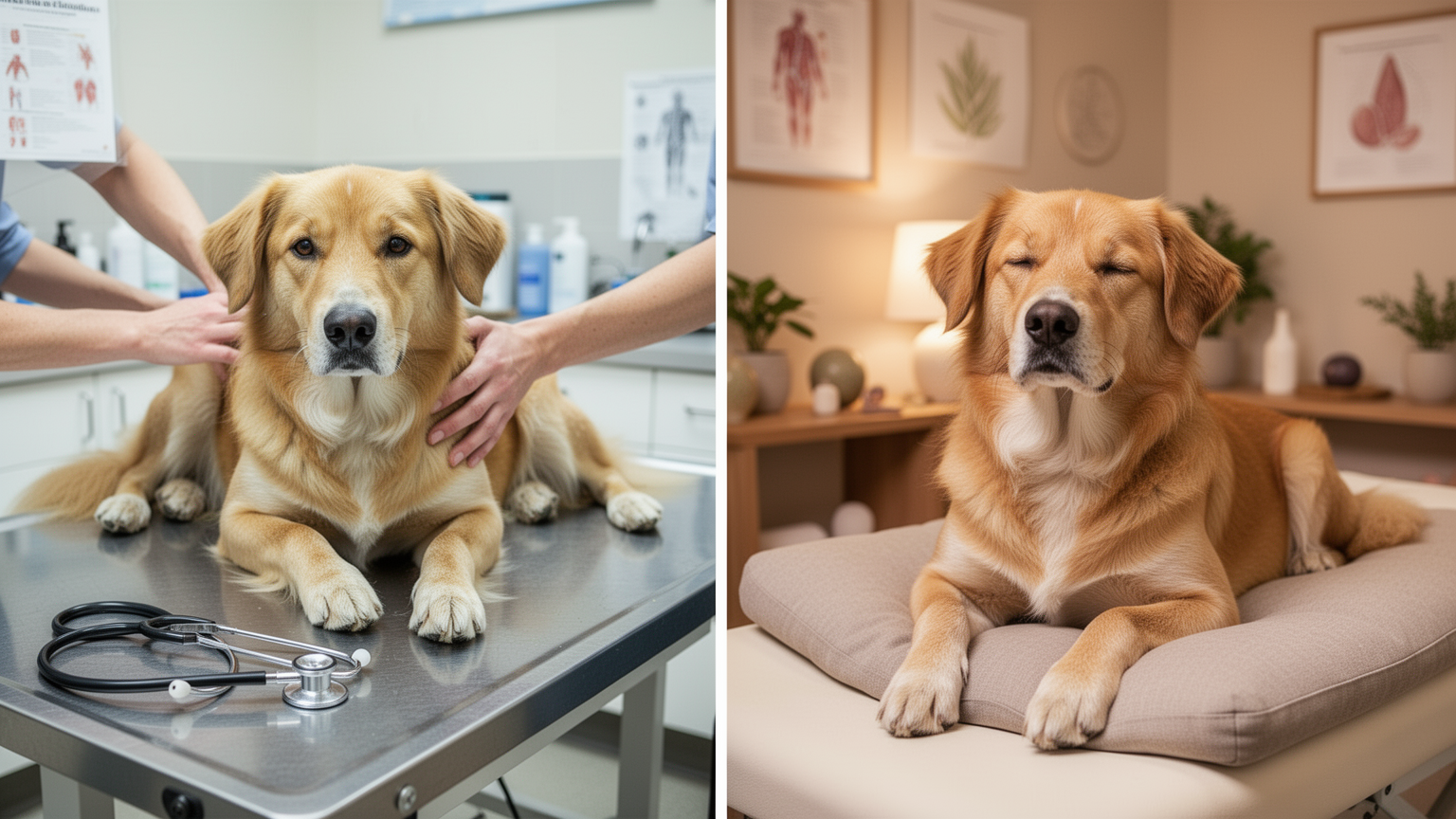
Here's the practical implication: before your holistic vet recommends acupuncture or herbs, your dog should have been seen by a conventional vet and have a clear diagnosis. You need to know what you're treating. A limp could be arthritis, a soft tissue injury, a neurological problem, or pain referred from the spine. Acupuncture helps arthritis; it doesn't fix a torn ligament. Herbal anti-inflammatory support might help, but it doesn't replace surgical repair if that's what's needed.
Good holistic vets will ask for your dog's conventional medical records and may even recommend that you continue seeing your regular vet during treatment. Bad ones will act as though your conventional vet's advice doesn't matter.
The safest approach is integrative care: conventional diagnosis and urgent treatment, with holistic methods added to manage chronic symptoms, speed recovery, or reduce medication side effects. This isn't about choosing one path. It's about using the right tool at the right time.
How to Evaluate a Holistic Vet's Credentials in Bangkok
This is where shopping around matters most. Not all holistic practitioners have equivalent training, and credentials are easy to misrepresent.
What to look for:
-
Conventional veterinary licence first. Any holistic vet practising in Thailand should have a Thai veterinary degree or equivalent international qualification recognized by Thai authorities. This means they can take a full medical history, perform a physical exam, interpret blood work, and understand drug interactions. If they don't have this foundation, they can't diagnose safely.

Legitimate holistic vets maintain professional credentials and clinical standards. -
TCVM or acupuncture certification from a recognized body. The International Veterinary Acupuncture Society (IVAS) is the primary credentialing body globally. IVAS-certified practitioners have completed at least 140 hours of acupuncture training and passed an exam. Check the IVAS registry to verify. Other programs exist, but IVAS is the most rigorous and portable standard. If a vet claims acupuncture training, ask specifically where they trained and for how long.
-
Herbal medicine training. This is less standardized than acupuncture. Look for evidence of formal study in TCVM herbal theory, not just "experience." Some vets take short workshops and call themselves herbal experts; others complete 200+ hours of structured coursework. Ask how they were trained and whether they follow established TCVM herbal protocols or make up formulas on the fly.
-
Willingness to refer or collaborate. A good holistic vet sees themselves as part of your dog's care team. They should be comfortable talking to your conventional vet, sharing records, and stopping treatment if it's not working. Vets who insist they alone can help your dog, or who encourage you to stop conventional medication without medical reason, are red flags.
-
Realistic claims. Acupuncture won't cure hip dysplasia, but it can reduce pain from it. Herbs won't cure diabetes, but they might help stabilize blood sugar alongside insulin. If someone claims their treatment cures serious disease, move on. Medicine-conventional or holistic-manages and improves, not always cures.
Questions to ask before booking: - What's your formal training in TCVM / acupuncture, and from where? - Are you IVAS-certified (for acupuncture)? - How long do you typically recommend treatment, and how will we know if it's working? - Will you communicate with my dog's regular vet? - What conditions do you see respond best to your approach?
What to Expect: Timeline, Cost, and Realistic Outcomes
Holistic treatment isn't fast, and it costs money. Knowing this upfront prevents disappointment.
Timeline: Acupuncture usually requires 4-8 sessions before you see meaningful change. Sessions are typically once weekly at first, then less often as improvement stabilizes. For chronic pain, you might do maintenance acupuncture monthly or quarterly long-term.
Herbal treatment also takes weeks. Formulae are adjusted based on response, so the first blend might not be the final one. Budget 4-6 weeks to assess whether something is working.
This is much slower than, say, antibiotics (which work in days) or pain relief medication (which works in hours). But it's also gentler on the body and often produces more lasting improvement, especially for chronic conditions.
Cost: Acupuncture sessions typically cost more than a conventional vet visit but less than a specialist consultation. Herbal formulas are ongoing expenses, usually monthly or every few months depending on the condition. Exactly how much depends on the clinic and your dog's condition, so get a quote from the start.
What "working" looks like: Realistic improvements are modest but real. An arthritic dog might walk more freely and climb stairs with less hesitation. A dog with chronic loose stool might have firmer stools but not perfect digestion. An anxious dog might be calmer but still reactive in new situations. You're aiming for better quality of life, not transformation.
Some dogs don't respond. Acupuncture works best in animals that are relatively young or middle-aged with good overall health. Very frail or very young dogs may not respond as well. Chronic conditions that have been untreated for years are harder to reverse than early intervention.
Sources
- American Veterinary Medical Association - Complementary, Alternative, and Integrative Veterinary Medicine Guidelines - professional consensus on integrating holistic and conventional care.
- International Veterinary Acupuncture Society - primary credentialing standard for veterinary acupuncturists and practitioner registry.
- VCA Animal Hospitals - Know Your Pet Client Education - clinical evidence on acupuncture efficacy, treatment timelines, and conditions most likely to respond.
FAQ
Q: Can I use acupuncture instead of pain medication for my dog's arthritis?
Not entirely. Acupuncture can reduce pain, but it's slower than medication and often works best combined with it. Talk to your vet about whether you might reduce medication dosage over time as acupuncture takes effect - but don't stop medication on your own.
Q: How do I know if a holistic vet is just making money off me and not helping?
Give it time - at least 4-6 weeks - but also stay observant. Your dog should show some measurable change: more mobility, better appetite, calmer behaviour, or improved digestion. If after 6 weeks there's no shift at all, ask the vet directly why and whether continuing makes sense. You should also be comfortable asking your regular vet for an honest second opinion on whether treatment is helping.
Q: Is herbal medicine safe alongside my dog's regular medications?
Usually, but not always. Some herbs interact with certain drugs. A qualified holistic vet will ask about all your dog's medications before prescribing herbs, and they should be comfortable discussing potential interactions with your regular vet. Never give herbs without telling your conventional vet what they are.
Q: Do I need to choose between a holistic vet and my regular vet, or can I use both?
You should use both. Your regular vet handles diagnosis, emergencies, and ongoing conventional care. A holistic vet adds complementary treatment for chronic issues. The best outcome happens when they can communicate. If either vet discourages you from seeing the other, that's not a good sign.